

An Official Lens: Below is a list of official documents on China’s elite digital strategies (Digital China, Cyber Great Power, and Smart Society) that are referenced on this website, organized chronologically.
Zheng Bijian (郑必坚), “Face the Challenge with Comprehensive Planning; Strive to Build a World Class Cyber Great Power in Ten Years” (直面挑战 统筹经略 力争十年建成世界一流网络强国), State Council Secretariat Second Bureau, April 3, 2013 | Analysis | Translation | Archive
Comment: This is Zheng Bijian’s classified 2013 proposal to the Central Committee to build China into a Cyber Great Power within ten years. A historic exchange.

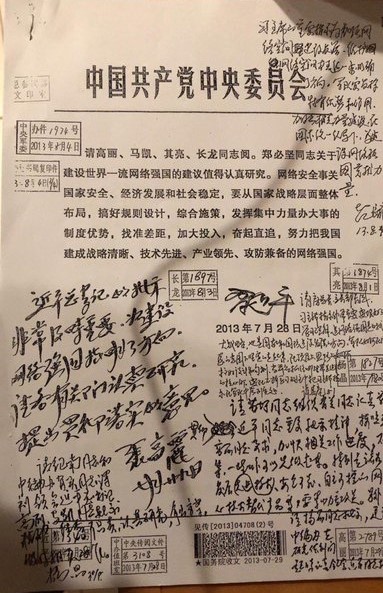
“Comrade Zheng Bijian’s Proposal on Building a World-Class Cyber Great Power Deserves Careful Study” (郑必坚同志关于建设世界一流网络强国的建议值得认真研究), Central Committee, July 28, 2013 | Analysis | Translation | Archive
Comment: This is the Central Committee’s classified response to Zheng Bijian’s 2013 proposal to build China into a Cyber Great Power within ten years. A historic exchange.
“Xi Jinping: Speech at the Work Conference for Cybersecurity and Informatization” (习近平:在网络安全和信息化工作座谈会上的讲话), Xinhua, April 25, 2016 | Analysis | Translation: China Copyright and Media | Xinhua
Comment: The term “information aorta” was coined by Xi Jinping in his famous “4.19” speech at the 2016 Work Conference for Cybersecurity and Informatization. The term quickly became the standard PRC media metaphor for “New Type Infrastructure,” and an important part of the Party’s historical narrative on Digital China.
“Central Committee General Office and State Council General Office Issue Outline of the National Informatization Development Strategy” (中共中央办公厅 国务院办公厅印发国家信息化发展战略纲要), Xinhua, July 27, 2016 | Analysis | Translation: China Copyright and Media , DigiChina | Xinhua
Comment: The 2016 Outline only includes a single reference to the high importance of accelerating Digital China in support of informatization on page 8 of the 17-page document, but it marks the emergence of the Party’s efforts to build a new narrative aligning Xi’s vision for Digital China with existing efforts at National Informatization. Notably, the Plan also contained the first official reference to the term New Type Infrastructure, although still in an unjelled form.
“State Council Guiding Opinion on Deepening “Internet Plus Advanced Manufacturing” and Developing the Industrial Internet” (国务院关于深化“互联网+先进制造业” 发展工业互联网的指导意见), State Council, November 27, 2017 | Analysis | Central Government
Comment: This document represents the early transition from the 2015 “Internet Plus” era to the 2020 “New Type Infrastructure” era. It is the bridge where the Party realized that simply “adding the Internet” wasn’t enough for digitalized transformation.
“Industrial Internet Development Action Plan 2018–2020” (工业互联网发展行动计划 2018-2020年), Ministry of Industry and Information Technology, May 31, 2018 | Analysis | MIIT
Comment: The plan describes 2018–2020 as the startup phase of China’s Industrial Internet construction, seeking to build the initial Industrial Internet infrastructure by 2020.
“Industrial Internet Special Working Group 2018 Work Plan” (工业互联网专项工作组 2018 年工作计划), Ministry of Industry and Information Technology, May 31, 2018 | Analysis | MIIT
Comment: The 2018 Work Plan established the Industrial Internet Special Working Group under the National Manufacturing Great Power Construction Leading Small Group, with SASTIND as an original member.
“Notice on Advancing the Accelerated Development of the Industrial Internet” (关于推动工业互联网加快发展的通知), Ministry of Industry and Information Technology, March 06, 2020 | Analysis | MIIT
Comment: Often summarized as the Industrial Internet “Twenty Measures,” the document calls for accelerating Industrial Internet development across six areas including New Type Infrastructure.
“Industrial Internet Innovative Development Action Plan 2021–2023” (工业互联网创新发展行动计划 2021-2023年), Ministry of Industry and Information Technology, December 22, 2020 | Analysis | MIIT
Comment: This plan marked the transition from startup to rapid growth, noting that the 2018–2020 startup-phase had been completed, and that 2021–2023 would be the rapid-growth phase.
“Industrial Internet Special Working Group 2022 Work Plan” (工业互联网专项工作组2022年工作计划), Ministry of Industry and Information Technology, April 06, 2022 | Analysis | MIIT
Comment: The shipbuilding industry appears directly in the 2022 Work Plan. The plan itself focuses on the acceleration of the “5G + Industrial Internet” initiative.
“Digital China Development Report 2021” (数字中国发展报告 2021年), Cyberspace Administration of China (国家互联网信息办公室), July 23, 2022 | Analysis | CAC
Comment: The report traces the origins of Digital China at the national level to Xi Jinping at the 18th Party Congress in November 2012, and linked Digital China to the concepts of Global Digitalized Development and Digitalized Transformation.
“Central Committee and State Council Issue ‘Plan for the Reform of Party and State Institutions’” (中共中央国务院印发党和国家机构改革方案), Xinhua, March 16, 2023| Analysis | Archive: Perma.cc | Translation: CSET , Ginger River Review
Comment: Section 14 of the Plan (Establish an NDA) includes three main points on managing implementation of Digital China: (1) NDA responsibilities, (2) CCAC responsibilities reassigned to the NDA, and (3) NDRC responsibilities reassigned to the NDA. Also see, the “Proposal (to the 14th NPC) on the Plan for the Reform of State Council Institutions (关于提请审议国务院机构改革方案的议案)” dated March 5, 2023.
“Guiding Opinions on Deeping the Development of Smart Cities and Advancing Whole-of-City Digitalized Transformation” (关于深化智慧城市发展 推进城市全域数字化转型的指导意见(发改数据), National Development and Reform Commission, National Data Administration, Ministry of Finance, and Ministry of Natural Resources, May 20, 2024 | Analysis | NDRC
Comment: This may be the first appearance of the term “Whole-of-City Digitalized Transformation” in an official document.
“Glossary of Commonly Used Terms in the Data Domain (Batch One)” (数据领域常用名词解释 第一批), National Data Administration, December 30, 2024 | Analysis | Translation | NDA
Comment: The NDA is building a formalized vocabulary for China’s emerging data governance regime, an action that may prove more consequential for China’s digital future than many of the high-profile AI headlines that dominate Western coverage.
“Reference Guide on the Fused Application of the Industrial Internet in the Shipbuilding Industry (2025)” (工业互联网与船舶行业融合应用参考指南), Ministry of Industry and Information Technology, Information and Communication Management Bureau and Manufacturing Industry No. 2 Bureau (工业和信息化部信息通信管理局和装备工业二司), June 5, 2025 | Analysis | Milestone | Translation | MIIT
Comment: China’s shipbuilding industry launched a major initiative to digitally transform its entire manufacturing process from ship design to ship delivery.
“Action Plan on Deepening Smart City Development and Advancing All-Domain Digitalized Transformation” (深化智慧城市发展推进全域数字化转型行动计划), National Development and Reform Commission, National Data Administration, Ministry of Finance, Ministry of Natural Resources, and Ministry of Housing and Urban-Rural Development, October 31, 2025 | Analysis | NDRC
Comment: This document reflects a continuing national effort to expand implementation of Smart Cities and Whole-of-City Digitalized Transformation.
Feedback & Corrections: Your questions, comments, additions, or corrections are always welcome! Please contact me at digitalchinawinsthefuture@gmail.com
AI Transparency: I use AI tools to support my editing, research, and translation process. Learn more on my AI Transparency Page.